
F.I.R.E
Retirement Iceberg : Things you don't see but suffer later

FabTrader
When you picture retirement, you probably imagine long walks on the beach, spending time with family, and finally having time to pursue your passions. But the reality is far more complex.
Think of retirement as an iceberg: what you see above the water — leisure, freedom, fixed pension, savings — is only a small part of the picture.
Beneath the surface lie hidden risks that can sink even the most carefully planned retirement strategy, especially in India, where social safety nets are sparse, medical costs are rising, and financial literacy remains patchy.
This article dives deep into the “Retirement Iceberg”: the overlooked challenges and practical ways to fortify yourself against them. These are the real, painful surprises that can catch you off guard, unless you plan ahead.
1. The Myth of Declining Expenses
It’s a common belief that expenses should drop after retirement. But data from India’s National Statistical Office and various retirement studies suggest otherwise.
Early retirement doesn’t mean you stop spending — quite the opposite. Studies show that medical expenses, home maintenance, family support, and lifestyle costs actually increase as time passes.
In India, nearly 30% of retired households face significant unexpected expenses within the first five years of retirement, especially for home repairs, medical emergencies, or urgent support to adult children or aging parents.
Case in Point
Mr. Rajesh Sharma, a 62-year-old former engineer from Pune, planned to live frugally post-retirement. But an unexpected heart surgery in his first year ate away almost half his retirement corpus. “We thought ₹50 lakh was enough to last us. No one told us healthcare inflation would outpace our projections,” he reflects bitterly.
💡 What You Can Do Today
- Plan for high medical inflation (consider 12-15% p.a., not 5%).
- Build a contingency fund of at least 2–3 years of expenses, separate from your regular savings.
- Take a comprehensive health insurance plan (including critical illness and hospitalization cover) — not just basic coverage.
- Avoid relying solely on fixed deposits or traditional savings; instead, allocate part of your corpus to conservative mutual funds that grow over time.
2. Longevity and Outliving Savings
Indians are living longer than ever: life expectancy has increased from 62 in 1980 to over 70 years today, and it is projected to cross 75 by 2050.
But few anticipate the “longevity risk” — the chance that you’ll outlive your assets.
Combine this with India’s volatile markets and the tendency to withdraw fixed amounts during bear markets, and you have a recipe for disaster.
A bear market in the early retirement years (say 2020 during the COVID crash) can permanently damage your savings ability. Studies show that if markets drop by 30% in the first 5 years of retirement, your withdrawal power shrinks by nearly half.
Example
An entrepreneur from Bangalore retired at 55 after selling his business. But a market crash wiped out 35% of his mutual fund investments in just 18 months. He had to postpone planned travel, dip into principal, and delay medical care.
💡 Smart Preparation Strategies
- Follow a “bucket strategy”: Keep 2–3 years of expenses in liquid instruments (FDs, short-term debt funds) to avoid selling equities during downturns.
- Use conservative assumptions: Plan for 3% real returns and 20–25 years of withdrawals.
- Do not withdraw a fixed percentage blindly. Instead, use dynamic withdrawal strategies (eg. 4% rule adjusted for market conditions).
- Consider annuity products from LIC or private insurers to cover a portion of your fixed expenses.
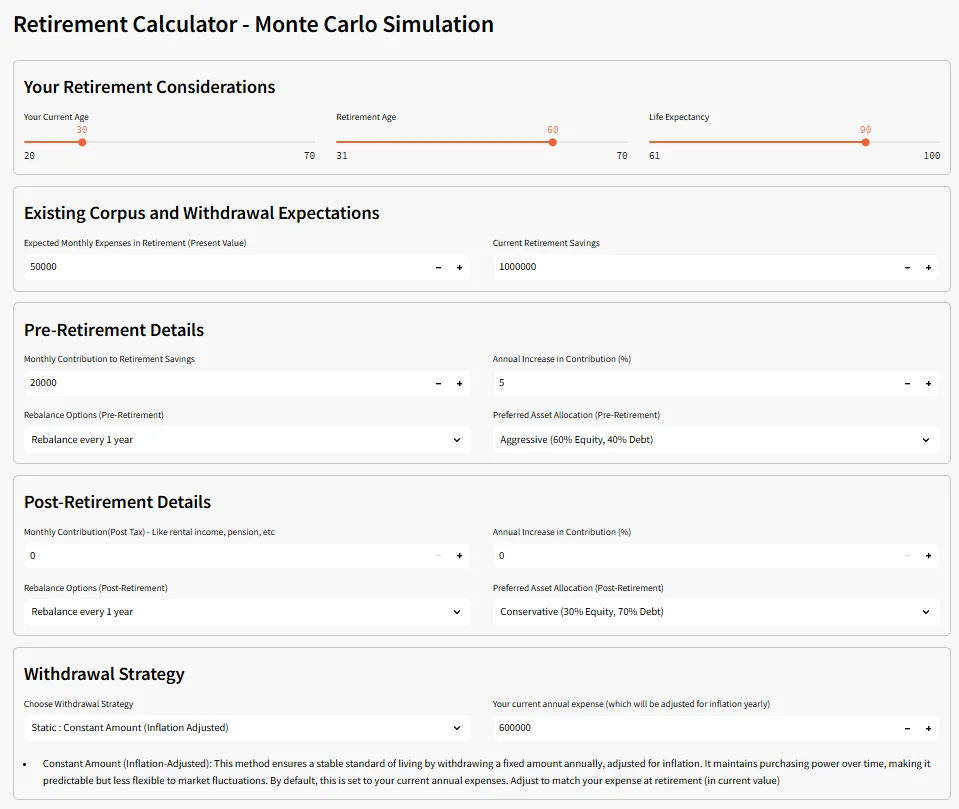
In case you are wondering how to plan your financials or not sure if your corpus would last your life span, checkout the free Retirement Calculator (Monte Carlo) on our Tools page.
3. Spending Shocks & Family Emergencies
Family is central to Indian life, but it’s also a major source of financial shocks in retirement:
- Supporting a struggling child’s marriage
- Funding a grandchild’s education
- Covering elder parents’ medical emergencies
- Gray divorce (divorce after 50) is rising in India, leading to asset splits and emotional trauma.
Fact
A 2023 survey by India’s Economic Times revealed that 22% of retirees had to dip into their savings for unplanned family support, reducing their corpus by 30% on average.
💡 How to Shield Yourself
- Build a separate “family support buffer” in addition to your emergency fund.
- Insure against major life risks (health, accidents, disability) through comprehensive insurance plans.
- Consider family counseling before major events (like gray divorce) to make joint financial decisions.
- Establish clear boundaries on financial support for adult children — “support, not dependency.”
4. Mental Health, Identity, and Addiction Risks
Work provides more than a salary — it provides purpose, structure, and social connection.
Post-retirement, many face:
- Loneliness: 1 in 4 Indian retirees report feeling isolated.
- Identity crisis: Loss of work leads to lack of purpose, eroding mental well-being.
- Rising addiction: Studies estimate 10–15% of retirees develop risky drinking or dependency on painkillers.
📖 Case Example
Mrs. Anjali Mehra, retired school teacher from Delhi, found herself disconnected after retirement. Without new hobbies or social support, she fell into depression and increasingly relied on alcohol.
💡 Proactive Steps
- Gradually “test-drive” retirement: Reduce work hours instead of abrupt stopping.
- Join clubs, volunteer, or take up a hobby that provides structure.
- Stay socially active — regular interactions with peers reduce loneliness.
- Seek help when needed. Mental health services in India are increasingly available but underutilized.
5. Cognitive Decline & Financial Vulnerability
Cognitive abilities — especially decision-making and numeracy — begin to fade in the 60s.
This exposes retirees to poor financial decisions and scams.
Study Insight
Researchers from Indian Institute of Management (IIM) found that 1 in 12 retirees developed signs of financial mismanagement within five years of retirement.
India reported ₹3,500 crores lost to pension and investment scams in 2023 alone.
💡 Safeguards to Implement
- Involve trusted family members in financial decisions early, with full transparency.
- Draft legal documents like power of attorney and nomination forms while you’re fully capable.
- Limit online exposure: Avoid risky digital investments and be cautious of unsolicited calls and messages.
- Regularly review and simplify your financial portfolio — complex products are a red flag.
6. The Invisible Safety Nets
Unlike the West, India’s pension system is patchy. Only about 20–25% of the workforce participates in formal pension schemes (EPF, NPS).
Social security is mostly limited to government employees. Most self-employed or private sector workers must rely entirely on personal savings.
💡 Concrete Actions to Build Resilience
- Start contributing to NPS (National Pension System) early.
- Build multiple income streams — part-time freelancing, renting property, or small business.
- Consider systematic withdrawal plans from mutual funds, rather than lump-sum withdrawals.
- Avoid over-leveraging assets. Pay off outstanding debt before retirement.
Final Takeaway: Prepare Today, Secure Tomorrow
The retirement iceberg hides many dangerous rocks:
- Inflation
- Unexpected medical costs
- Market volatility
- Cognitive decline
- Family shocks
But you don’t have to be a victim.
The smartest approach is not to chase FIRE blindly, but to embrace realistic planning and stress-test your plan against the worst-case scenarios.
🧱 Build buffers.
📈 Keep portfolios conservative as you age.
🧑🤝🧑 Stay connected.
📑 Legalize your finances early.
💡 Start small habits today: Set aside a health fund, take up a hobby, review your will.
As Mr. Sharma painfully learned, retirement is not just about money; it’s about resilience, purpose, and preparing for life’s hidden turns.
By proactively addressing these hidden risks, you can ensure a secure and fulfilling retirement. Remember, retirement planning is not just about accumulating wealth but also about preparing for life's uncertainties.
Frequently Asked Questions (FAQs)
Q: What are the hidden risks of retirement in India?
A: Retirement risks in India include rising medical expenses, longevity risk (outliving your savings), family emergencies, mental health challenges, cognitive decline, and lack of social security. Most retirees underestimate these factors, which can erode their financial stability over time.
Q: How much should I save for retirement in India?
A: Financial planners recommend accumulating at least 25–30 times your expected annual expenses at retirement as a starting point. This assumes you want your corpus to last 20–30 years post-retirement while factoring in inflation and medical costs.
Q: Is health insurance enough to cover medical expenses after retirement?
A: No. While health insurance is important, it often doesn’t cover critical illness, outpatient treatments, or medical inflation that grows at 10–15% per year. Building a separate health contingency fund of 2–3 years of expenses is essential.
Q: How can I protect my retirement savings from market crashes?
A: Adopt a conservative asset allocation as you approach retirement, keep 2–3 years of expenses in liquid assets (FDs, short-term debt funds), and avoid withdrawing from equity investments during downturns. Consider annuities to cover fixed expenses.
Q: Should I plan for family emergencies in my retirement corpus?
A: Yes. In India, it is common to support adult children, parents, or extended family during retirement. Set aside a dedicated “family support buffer” to avoid dipping into your retirement corpus for such expenses.
Q: What role does mental health play in retirement planning?
A: Mental well-being is critical. Retirement can lead to loneliness, loss of purpose, or depression. Proactively build hobbies, social connections, and purpose-driven activities into your retirement plan to stay mentally healthy.
Q: Are pension plans sufficient for retirement in India?
A: Pension plans (like EPF, NPS, and LIC annuities) help but cover only a small portion of your needs. Most retirees must rely primarily on personal savings, investments, and systematic withdrawal strategies.
Q: How can I avoid financial scams after retirement?
A: Keep your investment portfolio simple. Avoid risky digital schemes. Appoint trusted family members to help manage finances. Set up proper legal documents like power of attorney while cognitively sound.
Q: What is the “4% withdrawal rule” and does it apply in India?
A: The 4% rule suggests withdrawing 4% of your retirement corpus annually. However, due to Indian market volatility and higher inflation, a more conservative approach (e.g., 3% withdrawal) with flexible adjustment based on market performance is recommended.
Q: How early should I start planning for retirement?
A: Ideally, start planning in your 30s or 40s. The earlier you start, the more you benefit from compounding. Factor in inflation, rising medical costs, and family responsibilities early on
References and Further Reading
More from F.I.R.E
The FIRE Dream in India Is Changing — And Most People Haven’t Realised It
India’s growth story looks stronger than ever on paper. But beneath the headlines, something important is changing for salaried professionals, investors, and...
The 4% Retirement Rule — Thumb Rule or Middle Finger?
The 4% rule has become the most recycled sentence in retirement planning. Simple. Confident. Comforting. And possibly dangerous. This is not an...